
Free 2026 edition · Cross-border planning guide

Living & Retiring in Bali

Bali is a wonderful place to live or retire. For a U.S. citizen it’s also financially complex, in ways that differ sharply from the system you’re used to. This guide surfaces the friction early, in plain English, so you can plan around it.

  • Whether your KITAS makes you an Indonesian tax resident before you cross 183 days
  • Which permit fits your situation, and what each one forbids you from doing
  • The investment mistake that can quietly cost Americans the most
  • What happens to your IRA, 401(k), Roth, and Social Security
  • Why foreigners cannot hold Hak Milik, and what to hold instead
  • The order to make your moves in, month by month
GET THE FREE GUIDE

Instant download · 31 pages · No cost, no obligation

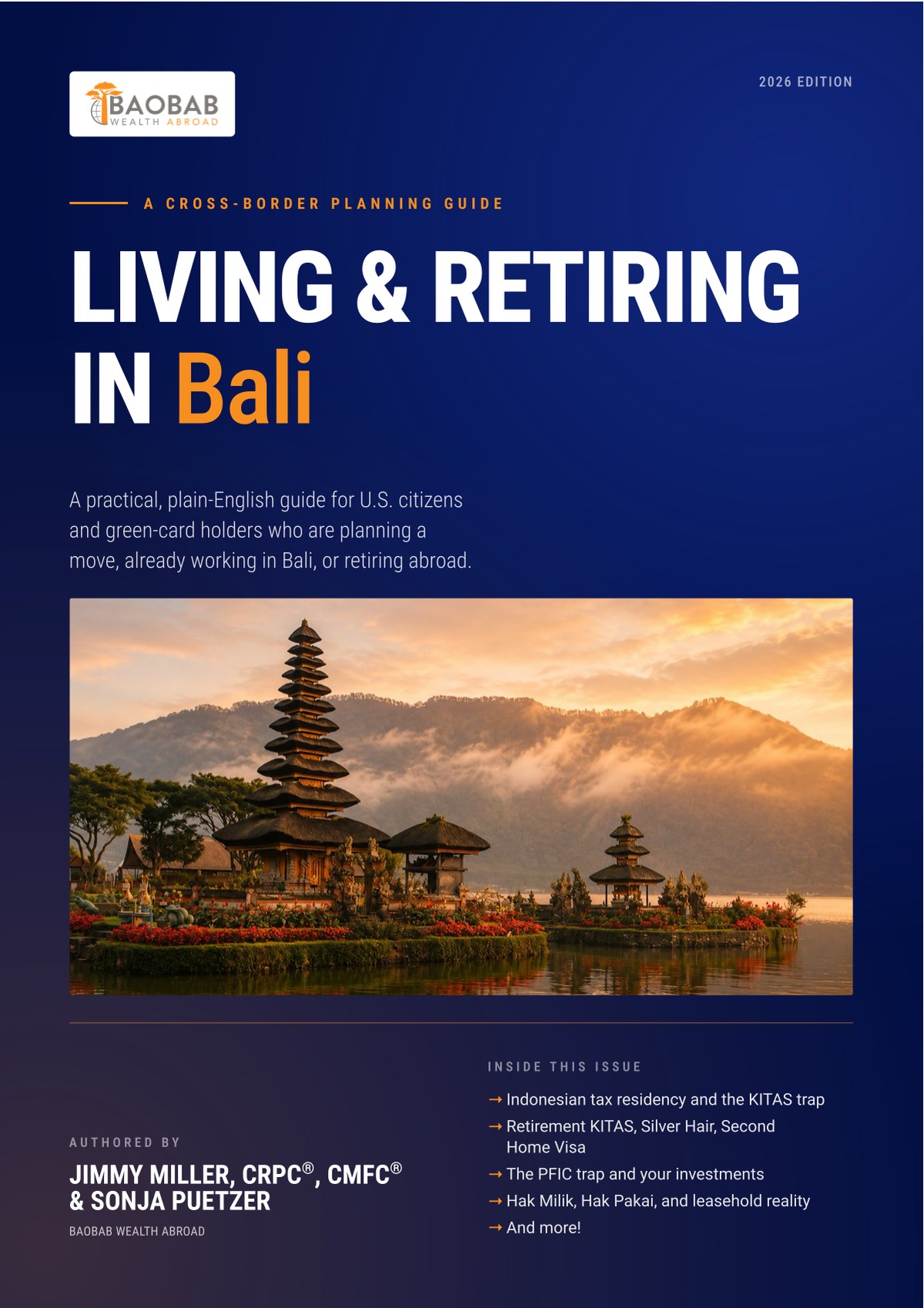
Cover of Living & Retiring in Bali, 2026 Edition, a cross-border planning guide from Baobab Wealth Abroad

Fee-based fiduciary Registered Investment Advisor

20+ years of experience

Serving cross-border families

Written by expats, for expats

Why this guide exists

Six reasonable assumptions that may turn out to be expensive.

None of these short case studies are careless decisions. Every one is a sensible conclusion that might happen to be wrong in a cross-border context, and each was avoidable with the right questions and proper planning.

What people assume

“My visa sorts out my taxes.”

What actually happens

It does not, though in Indonesia the two are linked more tightly than in most countries. A KITAS is usually treated as evidence of intent to reside, and KITAS holders are generally treated as tax residents from the date the permit activates, regardless of day count. Arrive in October assuming the 183-day rule protects you, and the Roth conversion you did in November may be exposed to Indonesian tax as well.


What people assume

“I’ll just invest through my Indonesian bank.”

What actually happens

The fund your local Indonesian bank offers is an ordinary product to them and a PFIC to the IRS. Most non-U.S. mutual funds and ETFs qualify as PFICs. Each one can carry punitive default taxation, an interest charge, and its own Form 8621 every year — an avoidable cost that comparable U.S.-domiciled funds would never have created.

What people assume

“We can buy the villa through a nominee.”

What actually happens

Foreigners cannot hold Hak Milik, Indonesia’s freehold title. The widespread workaround puts the land in an Indonesian citizen’s name with side agreements that may be unenforceable, and authorities have publicly signaled scrutiny of foreign land-ownership workarounds. Hak Pakai or a clean, independently verified leasehold is the route worth understanding.

What people assume

“Moving abroad ends my U.S. self-employment tax.”

What actually happens

It does not, and the U.S. and Indonesia have no totalization agreement. A consultant running a U.S. practice from Canggu can owe U.S. self-employment tax — 12.4% Social Security up to the 2026 wage base of $184,500, plus 2.9% uncapped Medicare tax — with no mechanism to offset Indonesian obligations that may apply on top.

What people assume

“We’ll rent out the villa while we travel.”

What actually happens

A Retirement KITAS restricts local income-generating activity, and operating a rental, even short term, is widely treated as falling inside that restriction, with separate tax and licensing questions of its own. Penalties for earning rental income without the right permit can be severe. If income is part of your property plan, that is a different visa structure, decided before you buy.

What people assume

“My IRA is tax-deferred, so nothing changes.”

What actually happens

Indonesia taxes residents on worldwide income and the 1988 treaty does little to shield retirement-account distributions, which are commonly treated as ordinary income at rates reaching 35%. A Roth’s tax-free withdrawal is not guaranteed to survive the move either. One illustration in the guide shows a couple’s tax bill rising rather than falling after the move.

The tax-residency line

183days

The statutory day-count test — but it is only one of the routes into Indonesian tax residency, and a KITAS can itself be treated as evidence of residency well before you reach it.

Freehold for foreigners

0Hak Milik

Indonesia’s full freehold title is reserved for citizens only. Eligible foreigners hold Hak Pakai or a leasehold instead — real, registered rights, but different ones worth understanding precisely.

The U.S. treaty

1988signed

Old, and narrower than people expect. It protects U.S. Social Security from Indonesian tax, does far less for IRAs and pensions, and there is no totalization agreement alongside it.

What you’ll walk away with

Sixteen short chapters. One clear takeaway each.

Built to be skimmed, returned to, and handed to your tax, legal, or financial professional.

GET THE FREE GUIDE
  1. Which route into Indonesian tax residency applies to you, and from what date it starts
  2. Whether the Retirement KITAS, Silver Hair, remote-worker, or Second Home route fits, and what each one restricts
  3. How to keep investing as a U.S. person without ever touching a PFIC
  4. What the treaty protects, what it leaves exposed, and what the missing totalization agreement costs
  5. How Hak Milik and Hak Pakai differ, and which one you can actually hold
  6. A 12-month checklist leading up to the move, plus seven things worth getting right

Built for you

Who this guide is for

  • U.S. citizens and green-card holders already living in Indonesia
  • Pre-retirees planning a move in the next one to two years
  • Working professionals, entrepreneurs, and families relocating to Bali
  • Retirees who want to build a sustainable retirement income plan that works in Indonesia

Probably not you

Who it isn’t for

  • Non-U.S. citizens with no U.S. tax filing obligations
  • Short-term tourists and seasonal visitors
  • Readers looking for loopholes or aggressive tax schemes

Get your free copy

Tell us a little about your situation and the guide opens immediately. We’ll also email you a copy so it’s there when you need it.

Moving to Bali is rarely a tax-saving strategy. The reason to move is the life you’ll live there. The reason to plan carefully is to make sure the money side holds up.

Free · Instant download

“*” indicates a required field.

We use your details to send the guide and follow up about cross-border planning. We hate SPAM and promise to keep your email address safe.

Written by

A fiduciary built for cross-border lives.

Jimmy Miller

Jimmy Miller, CRPC®, CMFC®

Founder · 20+ years experience

Jimmy is the founder of Baobab Wealth Management and Baobab Wealth Abroad, and offers advisory services through Baobab Wealth LLC, a Florida state-registered investment advisor specializing in cross-border families.

Read Jimmy’s full story
Sonja Puetzer

Sonja Pützer

Chief Compliance Officer · Investment Advisor Representative

Originally from Germany, Sonja spent two decades working across markets and cultures before moving into financial services. She brings a relationship-centered approach to every cross-border client conversation.

Read Sonja’s full story

This guide is educational and general in nature. It is not investment, tax, legal, or immigration advice, and it does not account for your individual circumstances. Baobab Wealth does not practice Indonesian law and does not provide Indonesian tax or immigration services. Scenarios are hypothetical composites, not descriptions of actual clients, and no outcome shown should be read as typical or expected. Figures are illustrative. Indonesian tax and immigration rules change frequently and are enforced unevenly; confirm current details with a qualified U.S. expat tax specialist and independent, appropriately licensed Indonesian professionals before acting.